

Investing in market index ETFs provide a generally diversified portfolio with the ability to track overall market returns. What if there is a method to beat the market returns with a simple mechanical and quantitative process?


Well, a strategy of simply buying the 10 per cent of the Singapore market with the lowest price-to-book (PTB) ratio, and rolling the money to the next basket of low PTB stocks the following year, would have yielded a return of 22 per cent a year during a 10 year period from end 2003 to 2013.
At this rate of return, the initial capital of $150,000 would have ballooned to about $1.09 million by early 2013. This is after accounting for 1.5 per cent transaction costs for each trade, and an annual performance fee of 20 per cent on high water mark for the manager who is executing the strategy. Compare that to the returns from STI ETFs and unit trusts at 13.2% to 13.9% pa in the chart below.
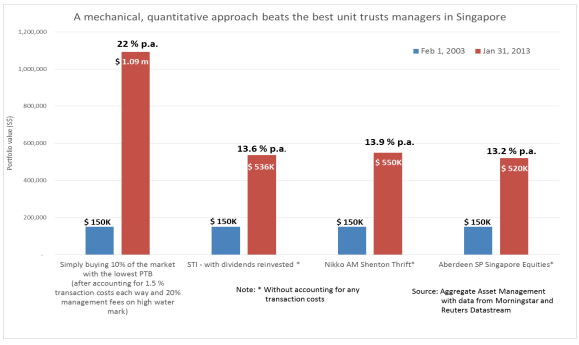
Increasing transaction costs to 3 per cent for buying and another 3 per cent for selling the stocks in the portfolio, with the same 20 per cent management fees applied, would reduce the return to 19 per cent a year. The end portfolio would be at $853,000. Note that the STI ETF and unit trusts do not account for transaction costs as well, to see the comparison read To Invest In Exchange Traded Funds or Unit Trusts?
Why does such a simple strategy work?
Well, because the low PTB stocks are generally down and out stocks. They could be in an unglamorous industry, or are going through a rough patch in their business cycle. Investors are always looking for the next exciting thing or the next novel idea in the market and are willing to pay a high price for it. And they tend to ignore the “dogs” of the market, or find it difficult to buy them. As a result, these companies end up trading at a fraction of the value of their underlying assets.
But in this world, nothing stays constant. Poor performing companies will restructure and start to perform better. Or, for some, their assets are taken over by competitors. In most instances, these companies will revert to the mean, or to the category of average performers. A stock which moved from a down-and-out state, to an acceptable state, would typically see a big jump in its share price. This explains the persistent outperformance of low PTB stocks versus the rest.
Fama and French, the US university professors who first discovered this phenomenon of low PTBs being the best predictor of future outperformance in share price, attributed the superior performance of the “dogs” portfolios to higher risk. Being “dogs”, they have more uncertain earnings stream and some may even have problems surviving. Investors who buy such companies are thus assuming a greater risk and therefore have to be compensated for it, they argued.
However, if one takes a portfolio approach, i.e. buy a big basket of such stocks, even if a handful of the companies don’t recover from their slump, the impact on the portfolio will be minimal. Often times, the gains from the other stocks in the portfolio will more than make up for the handful that have disappointed.
It is just our irrational fear of owning a basket of out-of-favour stocks which is deterring us from reaping the benefits of what study after study have shown to be a very lucrative stock investment strategy.
Why Unit Trusts Cannot Adopt This Strategy
Besides their higher expenses, their size is their other handicap. Because of the large amount of funds that they manage, big fund houses can only buy big capitalisation stocks whose shares are more liquid, i.e. frequently traded, and can absorb their fund flows. As we all know, big cap stocks generally trade at a premium. But even if they could, big funds are unlikely to hold this type “dog” portfolios.
Professional fund managers are humans too and many make the common cognitive errors of being attracted to what’s hot, rather than what’s not. Furthermore, they are highly motivated to try to minimize their career risks by simply buying the “safe” well-known companies. Consequently, big funds are less able and less likely to take advantage of the mispricing that happens more frequently in the small and medium cap space. That leaves the space free for savvy retail investors and the smaller and nimbler boutique funds to help themselves to the rich pickings.
The above article is written by Teh Hooi Ling, Head of Research at Aggregate Asset Management. Aggregate Asset Management is the manager of Aggregate Value Fund, a no management fee Asia equities fund.


Hi
Is there any study that shows the return for investing only in 5% of the lowest pb stocks?
Also, what is the recommended initial outlay to implement such a strategy for retail investors?
Will there also be the issue of odd lots being bought and sold which will incur higher transaction costs?
Thanks
Hi john, what do you mean by investing in 5% of the lowest pb stocks? You mean allocating 5% of your portfolio to the strategy?
This is a very specialized investment strategy that can be used by itself or with other FA screening criteria. As such there is no recommended outlay. However, if you rely on this strategy solely, make sure your portfolio is not dominated by small cap stocks, as there are likely to be the ones with very low P/B ratio.
As with any stock investments, you generally buy in full lots. Odd lots issue normally comes about from investing plans like the POSB Invest Saver.
https://drwealth.com/2014/09/11/beginner-investment-scheme-posb-invest-saver/
How does one screen and determine good stocks with low PTB ratio?
You can use stock screeners like Goggle Finance or SGX stock screener.