

Transiting from student life to a working adult, one rite of passage is the meeting of a financial advisor who would meticulously map out your insurance requirements for the coming decades. He or she would then require you to commit part of your income to protect against the unexpected illness or accident. It is painful to be caught off guard and could lead to financial ruin, we are told.
As a vehicle owner insurance is essential. After spending huge amounts on the car, the premiums are a small price to pay for peace of mind.


As a tourist, travel insurance protects against flight cancellations, loss of luggage and accidents while overseas. The holiday is an annual event, and we must do all we can to prevent things from going wrong.
As a concert goer you could ‘insure’ your tickets in case you are unable to attend for whatever reasons. When you purchase a TV or a laptop or a washing machine or a refrigerator they now come with the option of an extended warranty.
As human beings it is innate to protect things that matter to us. The car, the holiday trip, the brand new laptop. They are of value to us and we would gladly pay a small premium to protect them.
Now pause for a moment and ask yourself. Is your net worth important to you? Are your assets important to you? The basket of stocks and shares and unit trusts you have accumulated over the years; are they valuable to you and would you want to see anything happen to their value at all?
If your answer is yes, look no further than these five ways to protect your investment portfolio.
———————–
Short Selling
Instead of buying low selling high, short sellers flip the game around by borrowing and selling shares that they do not own. Should the price of the share decrease, they would be able to buy back their shorts at a lower price hence reaping a profit. When prices rise and short sellers need to cover, they need to buy back at higher price, hence leading to a loss.
Unlike long positions, short positions tend to be more vulnerable. Buying a share priced at $10 will incur a maximum loss of $10 (100%) when the price goes to zero. However, shorting a share or a fund opens one up to unlimited potential losses because the price could theoretically increase to $100 or even $1000.
The risk reward ratio for shorting tend to be asymmetrical. Hence, brokers often require a margin to be maintained. In the Singapore market, outright shorting of shares is not allowed and one can only short sell via Contracts for Differences.
When going short, one also needs to take into account dividend payouts. Instead of receiving dividend like one would when owning shares, dividend would be paid out from the short seller’s account.
Going short gives another dimension to a trader’s strategy. It is a useful tool in the investor’s kit especially when the market is volatile and a decline is imminent. However, it requires the investor to time the market well as a portfolio protection strategy over the long run it is impracticable.
Inverse ETF
An Exchange Traded Fund is an instrument traded on the exchange just like stock counters. Investors can buy or sell them just like any stock. ETFs are specific in their purpose. Some of them track the price of a commodity, others a specific sector. An ETF that local retail investors tend to be more familiar with is the STI ETF. As the name suggests, the STI ETF tracks the Straits Times Index by holding STI component stocks.
The price of a regular ETF will increase when the price of the asset or index it is meant to track increases. An Inverse ETF on the other hand is constructed by using various derivatives to allow the investor to profit from a decline in prices of the asset. Some Inverse ETFs are also constructed with built in leverage such that when the price of the underlying declines, the price of the ETF will advance by a multiple of that.
A good example is the Proshares Ultra Short S&P 500 (SDS). The summary states ‘the fund seeks daily investment results that correspond to two times the inverse (-2x) of the S&P 500’. In other words, on any day that the S&P 500 falls by 3%, the price of SDS should increase by 6% correspondingly. Instead of shorting the S&P 500 one could go long SDS. Essentially the SDS is a good tool for anyone with a bearish view of the market.
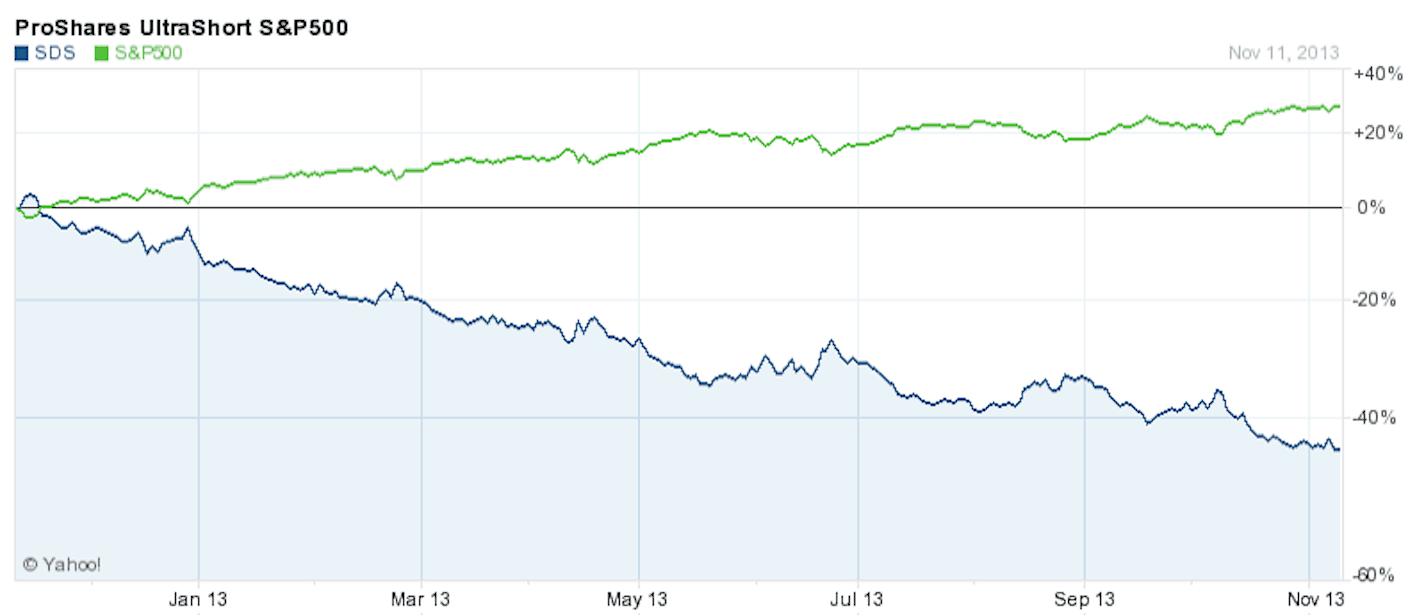
A note of caution though. Because they attempt to replicate returns via derivatives and swaps, the fund manager is guided by an operating time frame. SDS is pegged to daily returns and hence suited more for day traders. Over the long run there will be significant slippage.
Option Strategy
Owning a call option allows an investor the right to purchase a particular stock at a specific strike price before the expiry of the option. The opposite of a call option is a put option, and owning that allows an investor the right to sell a particular stock at a specific strike price.
 Let us use Apple Corp as an example. The stock is currently trading at $525 now and the following shows the price of options expiring on the 15th November (typically the third Friday of the month being the last trading day of monthly options).
We could spent $1.40 purchasing the Nov13 500 Put. Each contract of 100 shares, valued at $140 allows us to sell 100 shares of AAPL at $500 at any time before the option expires. Assuming the price of AAPL remains above $500, our put option contract would expire worthless and we would have spent $140 on the protection. In the event that the market tanks and the stock price declines by 10% to $472 before 15 November, our options would now be worth $2800. In the highly unlikely event that the company is hit by a series of bad news and the price tanks 20% to $420, our position would now be worth $8000.
Owning put options allows an investor to hedge against market declines. However, the premium could add up to a substantial amount over time and it takes patience and perseverance for the strategy to pay off. A strategy that purports to lose money consistently and reap rewards once in a blue moon is only for the strong of heart and mind.
Long VIX
VIX is the ticker symbol for the Chicago Board Options Exchange Market Volatility Index. VIX measures the implied volatility of the S&P500 index options. When the market ranges or trends in a predictably sedate fashion, VIX remains low and trades below 20. When the market is predicted to move sharply, the price of options premiums increase, and VIX increases as well. During a market crash, VIX spikes and investors hoping to protect themselves against volatile market conditions could do so via exposure to VIX.
Unfortunately VIX by itself is not a tradable security and one would have to proxy it through other instruments. One such instrument is the iPath S&P500 VIX ST Futures ETN (VXX). This particular Exchange Traded Note (ETN) uses futures to track the rise and fall of VIX. Like the Proshares Ultra Short Inverse ETF (SDS), VXX is tradable through normal channels and via any broker that offers trading in the US market.
However, as a long term hedge, VXX does have its shortfalls. Because its strategy is to buy futures on VIX, it bleeds gradually and over time the value diminishes to zero.
Asset Allocation
The typical retail investor in Singapore would have a large part of his or her net worth tied up in property and would have invested mainly in the stock market. This presents a problem, because when the global economy experiences a downturn, the value of property and portfolio would experience a significant decline.
We have written much about the Singapore Permanent Portfolio, whereby the entire portfolio consist of equal shares of stocks, bonds, gold (commodities) and cash. By itself each asset class is volatile. Combined, they reduce the volatility and make for steady and constant returns.
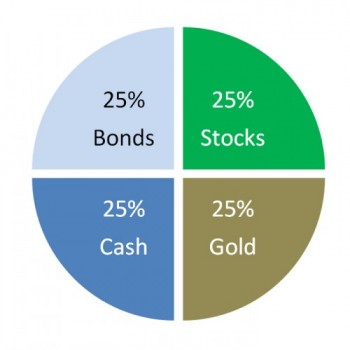
In a crash, when the market is in recession, money will flee to safer assets such as bonds and commodities. Hence the fall in the value of stocks will be more than made up for in the rise of bond and commodity prices.
As a hedge against market volatility, the Permanent Portfolio is an efficient and effort free method which we highly recommend.
Conclusion
We have listed five ways to insure your portfolio and ensure that its value holds up in a bear market. None are perfect, but we are sure you will be able to find one to protect your portfolio against market declines.


Hi Alvin,
If I am going to subscribe to Peoms Sharebuilders Plan with monthly contributions from my CPF, can this form the 25% component of the Permanent Portfolio? Will this monthly plan makes rebalancing difficult?
I was also looking at the SGS bond on Peoms and saw that the longest maturity is only 17 years. I cant find any SGS 30 years old. So, what other better options are there? thanks!
hi eve,
I don’t think you can use cpf funds for share builders plan. pls check with your remisier.
you should not mix dollar cost averaging with permanent portfolio. it will affect the rebalancing.
you shd look at the stocks page to find the 30 year bonds. they are listed on sgx.