
Dr Wealth
  • Articles
    • Singapore Stocks
    • Malaysia Stocks
    • China Stocks
    • US Stocks
    • REIT
    • ETF
    • Fixed Income
    • Personal Finance
    • CPF
    • Property
    • Cryptocurrency
  • Videos
    • Dr Wealth YouTube
    • Dr Wealth TikTok
    • Early Retirement Investor
  • Newsletters
    • Dr Wealth Weekly Newsletter (Free)
    • Growth Dragons
    • Finbite Insights
  • Courses
    • Intelligent Investors Immersive
    • Turbo Stocks Trading
    • Early Retirement Masterclass
    • All-Weather Portfolio Masterclass
    • Cryptocurrency Masterclass
    • Property Investing Course
No Result
View All Result
Join Newsletter
Dr Wealth
  • Articles
    • Singapore Stocks
    • Malaysia Stocks
    • China Stocks
    • US Stocks
    • REIT
    • ETF
    • Fixed Income
    • Personal Finance
    • CPF
    • Property
    • Cryptocurrency
  • Videos
    • Dr Wealth YouTube
    • Dr Wealth TikTok
    • Early Retirement Investor
  • Newsletters
    • Dr Wealth Weekly Newsletter (Free)
    • Growth Dragons
    • Finbite Insights
  • Courses
    • Intelligent Investors Immersive
    • Turbo Stocks Trading
    • Early Retirement Masterclass
    • All-Weather Portfolio Masterclass
    • Cryptocurrency Masterclass
    • Property Investing Course
No Result
View All Result
Dr Wealth
No Result
View All Result

Fixed Income Exchange Traded Fund – Benefits and Risks that You Must Know

Louis Koay by Louis Koay
October 29, 2013
in ETF, Investments
1

There are several ways to invest in fixed income market. One of them is investing in Fixed Income ETF. Below are the advantages and the risk of investing in Fixed Income ETF:

Diversification

The underlying asset for fixed income ETF comprises dozens if not thousands of bonds. This will help to diversify your risk of investing in one or few bonds. The diversification benefit for fixed income ETF is not only diversification across different industries or countries, but it also diversify into different credit rating of bonds. This mix credit rating of bonds will help to reduce the concentration risk, which is the risk of investing in one or few bonds and the bonds failed to pay its obligations.

You might also like

How to Invest and Store Gold in a Singapore Vault from US$5

How to Invest and Store Gold in a Singapore Vault from US$5

March 6, 2026
How We’re Investing in 2026

How We’re Investing in 2026

January 27, 2026

Liquidity

Although individual bonds are traded on the SGX, the trading volumes for most of the bonds are very low. This will reduce your liquidity of trading the bonds. On the other hand, fixed income ETF is relatively more actively traded in SGX as compared to individual bond. Also because of higher trading volume, the buy-sell spread for fixed income ETF is generally lower.

No maturity date

This is the main difference between fixed income ETF and individual bond. As we know, bond has a maturity date. For the fixed income ETF, even though the underlying asset for the ETF is bond, ETF has no maturity date. This is because the ETF will replenish the old bond to a new issued bond when the old bond reaches its maturity date. This is an advantage for investing in ETF as you don’t need to search for new bond to invest when the old bond reaches its maturity date.

Low management fees

Fixed Income ETF has relatively lower management fees as compared to unit trust that investing in the fixed income market.  The management fee is generally lower than 1% for fixed income ETF. The low management fees of ETF as compared to unit trust is because ETF is less actively manage.

Risk (Interest rate risk)

Similar to the other fixed income asset, fixed income ETF is highly correlated to the interest rate. When the interest rate goes up, the price of fixed income ETF goes down. The easiest way to measure the correlation between interest rate and the price of fixed income ETF is by using effective duration. For example, if the effective duration is 5, this means that for every 1% increase in interest rate, the price of fixed income ETF will decrease by 5%.

Examples of Fixed Income ETF listed on SGX

The following are the examples of Fixed Income ETF listed on SGX:
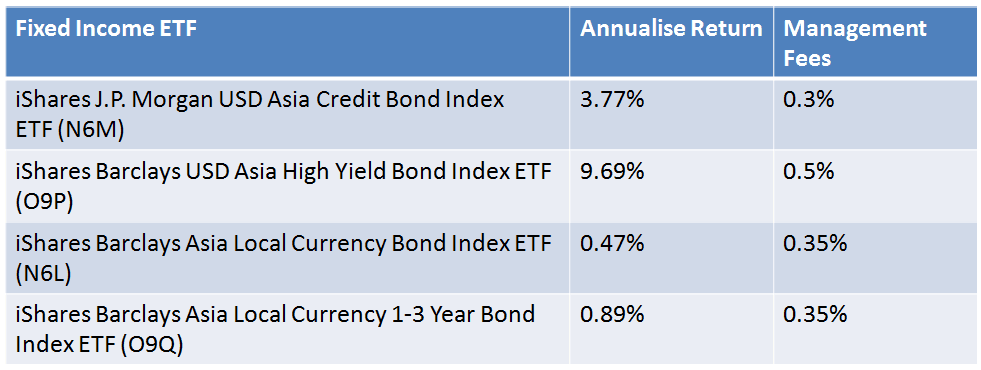
bond ETF

Conclusion

It is advisable to invest in fixed income ETF as compared to investing in individual bond. But do note that fixed income asset will underperform in the rising interest rate environment. However, due to the low correlation between fixed income assets and equities, it is better to have fixed income investment in your portfolio so that you can optimize the risk and return of your portfolio.

Louis Koay

Louis Koay

Louis Koay is a dual-licensed representative at Phillip Securities Pte Ltd. He is also a trainer at Dr Wealth. He graduated from the National University of Singapore with First Class Honours and he is a CFA charterholder as well as a Certified Financial Planner. He is currently managing a team of 42 advisors and servicing more than 7,800 clients with asset under servicing of more than $500 million. Louis is the creator and trainer of the Personal Finance Fundamental Course, and the co-trainer for Intelligent Investors Immersive Program. He has trained more than 20,000 retail investors in analysing stocks and personal financial planning.

Related Stories

How to Invest and Store Gold in a Singapore Vault from US$5

How to Invest and Store Gold in a Singapore Vault from US$5

by Dr Wealth
March 6, 2026
2

Gold has been on an absolute tear. In the past year alone, it delivered a whopping 69% return—making it one...

How We’re Investing in 2026

How We’re Investing in 2026

by Alvin Chow
January 27, 2026
0

I tried something different this year—a roundup with different investors sharing their 2026 outlook. I did one with fund managers,...

Where Fund Managers See Opportunities in 2026

Where Fund Managers See Opportunities in 2026

by Alvin Chow
January 20, 2026
0

It's 2026, and everyone wants a peek into what the year might bring. Good news? Bad news? Both? No one...

CSOP Brings China’s A500 to Singapore – A500 vs A50 vs CSI 300: Which to Choose?

CSOP Brings China’s A500 to Singapore – A500 vs A50 vs CSI 300: Which to Choose?

by Yen Yee
January 13, 2026
0

China remains the world’s second-largest economy. Investors who want diversification beyond the US-centric growth story will appreciate exposure to the...

Comments 1

  1. momo says:
    12 years ago

    Hi, you missed out currency risk, something which may increase the volatility in SGD terms. There are no good fixed-income passive ETFs in Singapore, so I turn to unit trusts for bonds.

    Reply

Leave a Reply Cancel reply

Your email address will not be published. Required fields are marked *

BigFatPurse Pte Ltd

140 Paya Lebar Road, #06-12
AZ @ Paya Lebar
Singapore 409015
Tel: 65-9812 0411
Email: admin@drwealth.com

Subscribe for actionable market insights in your inbox!

  • Facebook
  • Instagram
  • YouTube
  • TikTok
  • X
  • Telegram

About Us

Disclaimer

Privacy Policy

© Dr Wealth 2026

No Result
View All Result
  • Articles
    • Singapore Stocks
    • Malaysia Stocks
    • China Stocks
    • US Stocks
    • REIT
    • ETF
    • Fixed Income
    • Personal Finance
    • CPF
    • Property
    • Cryptocurrency
  • Videos
    • Dr Wealth YouTube
    • Dr Wealth TikTok
    • Early Retirement Investor
  • Newsletters
    • Dr Wealth Weekly Newsletter (Free)
    • Growth Dragons
    • Finbite Insights
  • Courses
    • Intelligent Investors Immersive
    • Turbo Stocks Trading
    • Early Retirement Masterclass
    • All-Weather Portfolio Masterclass
    • Cryptocurrency Masterclass
    • Property Investing Course

© Dr Wealth 2026

Are you sure want to unlock this post?
Unlock left : 0
Are you sure want to cancel subscription?