


In April, a five-room flat on Henderson Road (City Vue @ Henderson) sold for S$1.728 million. That’s the most anyone has paid for an HDB flat. In the three months to September, 597 flats changed hands for S$1 million or more, another record by our count of HDB’s data. The median resale price hit S$638,000, also a record.
Yet on 1 October, HDB said resale prices fell for a third quarter in a row. Its flash estimate has the resale price index down 0.2% in the third quarter, after falls of 0.1% and 0.3%. The same day, URA said private home prices rose 1.4%.


So are HDB prices falling or breaking records? And why are condos going the other way?
We went through every HDB resale since 1990 to find out.
How Can Prices Fall When Records Keep Breaking?
Both are true, because they measure different things.
The million-dollar count and the median price tell you which flats sold. HDB’s index tries to tell you what the same flat is worth from one quarter to the next.
The million-dollar flats sold last quarter were 15 years old at the median. Toa Payoh had the most, as the Bidadari blocks have just passed their minimum occupation period, followed by Queenstown and Bukit Merah. As more of these flats become available to sell, more million-dollar deals show up, even if no single flat is worth more than last year.
Compare like with like and the picture flips. We matched flats by town, flat type and age, then compared the price per square metre in the third quarter of 2025 with the third quarter of 2026.

Flats aged five to nine years rose 0.7%. Everything older fell, and the older the flat, the bigger the fall. Flats 40 years or older fell 2.7%. Across all flats, prices were 1.3% lower. HDB’s own index, which uses a different method, fell 0.6% over the same year. Either way, the direction is the same.
So the records are real, but they come from a small, young slice of the market. If you own an older flat, the index is closer to your experience than the headlines are.
Has This Happened Before?
Yes, five times since 1990.


This is the gentlest start of them all. Three quarters in, prices are 0.6% lower. At the same point, they were 3.9% lower in 2013 and 5.5% lower in 1997.
The falls came in two kinds.
1997 and 2000 were crises. The Asian financial crisis hit just as HDB was building at full speed. Demand collapsed, and by 1999 HDB was sitting on more than 31,000 unsold flats. Prices fell 28%. Anyone who bought at the 1996 peak waited until 2008 to get their price back.
2013 was policy. That year the government brought in the Total Debt Servicing Ratio, cut the longest HDB loan from 30 to 25 years, lowered the share of income that can go to the mortgage from 35% to 30%, and made new permanent residents wait three years before buying a resale flat. Prices didn’t crash. They slid for six years, 12% in all, and only got back to their 2013 peak in 2021.
We think this one looks like 2013, only gentler. There is no crisis. More flats changed hands last quarter, 7,528 on HDB’s flash, up 17.7% on the quarter. Buyers are still there. They just aren’t paying more.
The third-quarter figure is a flash estimate, and the final comes later in October. So we checked every flash since 2014 against its final figure.
In 47 quarters, the final never went the other way. When prices were rising, the final usually came in 0.1 to 0.2 points higher than the flash. When prices were falling, the flash was almost always spot on. A third fall is as good as confirmed.
Why Are HDB Prices Falling While Condos Rise?
You might blame interest rates. But higher rates should hurt condo buyers more, because they borrow more, and the HDB loan rate is pegged at 2.6% no matter what the banks charge. Rates can’t explain why condos rose while HDB fell.
Three things do.
The same family sits on both sides. Once a flat passes its five-year minimum occupation period, the owner can sell it, or buy a private home without selling first. An upgrader adds a seller to the HDB market and a buyer to the condo market at the same time. Last quarter, suburban condos rose the most, by 2.2%, and that’s where many upgraders shop. Condos in the city centre fell 0.1%.
The number of these families is growing again. About 7,000 flats reached their minimum occupation period in 2025, the fewest in years. This year it is about 13,500. By 2028 it is about 21,400.
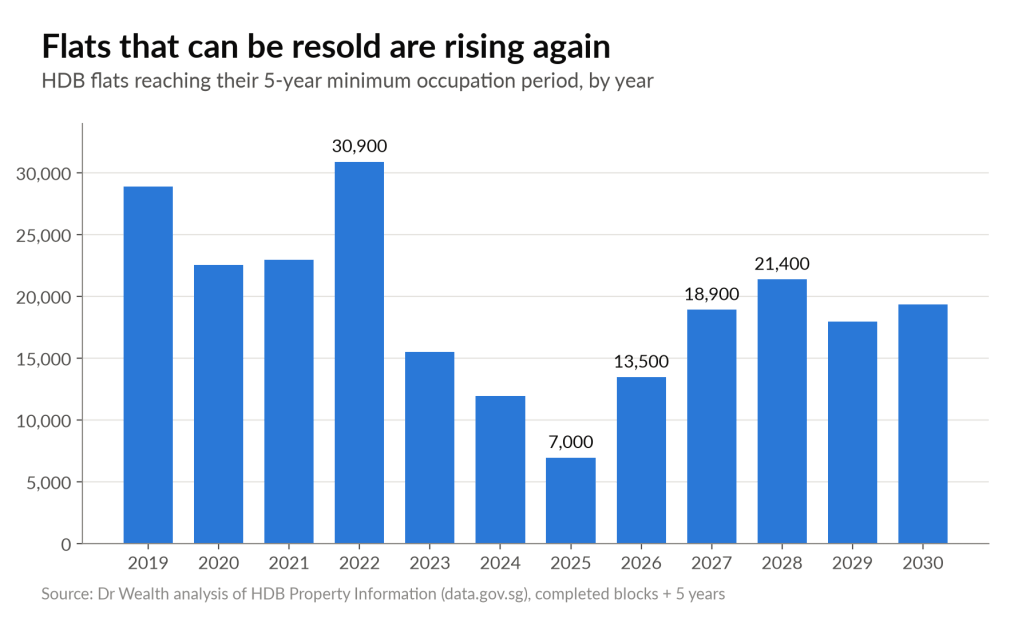
That isn’t the whole story, though. In 2022, almost 31,000 flats reached their minimum occupation period and prices still rose 10%. The difference was BTO. Covid delayed about 85% of BTO projects by six to nine months, and households who couldn’t wait had to look at resale instead. That queue is clearing now. HDB launched about 102,300 BTO flats from 2021 to 2025, more than its target of 100,000, and is launching another 19,600 this year. About 4,000 of those will be ready in under three years. Buyers have a real alternative to resale again.
The rules have leaned on HDB, not condos. In August 2024 the government cut the HDB loan limit from 80% to 75% of the price. Then in July this year it went the other way and scrapped the 15-month wait for private owners who sell up and buy a resale flat. We wrote at the time that this would steady HDB prices by the end of the year. We were wrong. HDB says it has not seen a significant increase in resale flats bought by private owners since.
Money at the top keeps growing. Landed homes led private prices for a second quarter, up 2.8% after 2.5%. About 376,000 households living in HDB flats have a household income of S$15,000 a month or more, according to the 2025 General Household Survey. That’s enough income to borrow for a condo. As long as incomes at the top keep rising, condo prices have a deep pool of buyers to draw on.
Put together, over the year to September, private prices rose about 3.4% while HDB prices fell 0.6%.
So How Now?
We think HDB prices will drift flat to slightly lower until the wave of flats reaching their minimum occupation period peaks around 2028. Not a crash. A long wait, like 2013.
What that means depends on where you stand.
If you’re upgrading, the gap is your risk. Over the past year your flat stood still while the condo you want rose about 3.4%. On a S$1.5 million condo, that’s about S$50,000 more.
If you’re buying a resale flat, time is on your side. More sellers are coming every year to 2028, and BTO is a real alternative again. Young flats in central estates are the exception. They are still rising.
If you own an older flat, a fall of a percent or two changes nothing if you plan to stay. But older flats are falling fastest, and lease decay doesn’t wait for the market to turn.
For more insights, join our Telegram: https://t.me/+TXFmvRr6tkgwYTc9


