
Dr Wealth
  • Articles
    • Singapore Stocks
    • Malaysia Stocks
    • China Stocks
    • US Stocks
    • REIT
    • ETF
    • Fixed Income
    • Personal Finance
    • CPF
    • Property
    • Cryptocurrency
  • Videos
    • Dr Wealth YouTube
    • Dr Wealth TikTok
    • Early Retirement Investor
  • Newsletters
    • Dr Wealth Weekly Newsletter (Free)
    • Growth Dragons
    • Finbite Insights
  • Courses
    • Intelligent Investors Immersive
    • Turbo Stocks Trading
    • Early Retirement Masterclass
    • All-Weather Portfolio Masterclass
    • PowerUp Options Mastery Course
    • The Weekend Portfolio
    • Cryptocurrency Masterclass
    • Property Investing Course
No Result
View All Result
Join Newsletter
Dr Wealth
  • Articles
    • Singapore Stocks
    • Malaysia Stocks
    • China Stocks
    • US Stocks
    • REIT
    • ETF
    • Fixed Income
    • Personal Finance
    • CPF
    • Property
    • Cryptocurrency
  • Videos
    • Dr Wealth YouTube
    • Dr Wealth TikTok
    • Early Retirement Investor
  • Newsletters
    • Dr Wealth Weekly Newsletter (Free)
    • Growth Dragons
    • Finbite Insights
  • Courses
    • Intelligent Investors Immersive
    • Turbo Stocks Trading
    • Early Retirement Masterclass
    • All-Weather Portfolio Masterclass
    • PowerUp Options Mastery Course
    • The Weekend Portfolio
    • Cryptocurrency Masterclass
    • Property Investing Course
No Result
View All Result
Dr Wealth
No Result
View All Result

STI ETF vs MSCI Singapore ETF

Alvin Chow by Alvin Chow
September 12, 2013
in ETF, Investments
4

Retail investors should be familiar with FTSE Straits Times Index (STI) while futures traders would prefer MSCI Singapore (SIMSCI). The purpose of these two indices is to provide a measurement of investment returns by selecting a basket of stocks listed on the Singapore Stock Exchange. The STI was constructed by Singapore Press Holdings and FTSE has refine the calculation with her methodology in recent years, MSCI is American while FTSE is British. Maybe because of Singapore’s British colony heritage that we chose to go with FTSE.

What is the difference?

I scoured through the methodologies briefly and found little differences in them. Both combined the elements of market capitalisation and liquidity (or transaction volume) to decide the stocks and their weightage in the indices.

You might also like

How to Invest and Store Gold in a Singapore Vault from US$5

How to Invest and Store Gold in a Singapore Vault from US$5

March 6, 2026
How We’re Investing in 2026

How We’re Investing in 2026

January 27, 2026

After scoring the Singapore stock universe, both indices came up with 30 constituents, and 25 of them are similar. See the constituents and the respective weightage in the table.
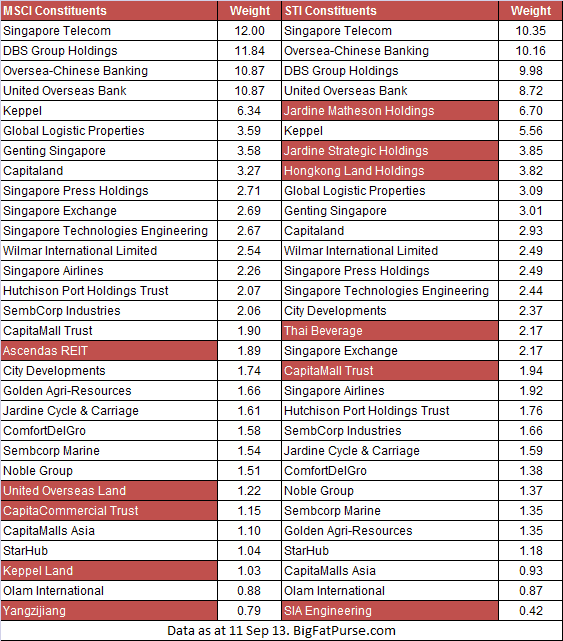
MSCI vs STI Constituents

Which one to invest in?

Besides the popular SPDR and Nikko AM STI ETF, iShares MSCI Singapore ETF is also listed in SGX. Retail investors are able to invest in either indices. iShares MSCI Singapore ETF is also listed in New York Stock Exchange.

Most importantly, what are the returns? For the period of 31 Aug 2003 to 31 Aug 2013 (10-year), the annual returns inclusive of dividends are

  • SPDR STI ETF: 9.92%
  • iShares MSCI Singapore ETF: 12.97%

A first look tells us that iShares MSCI Singapore ETF has given an additional 3% annual returns in comparison to SPDR STI ETF! But do not be too happy yet. The iShares MSCI Singapore ETF is quoted in USD. If we convert to SGD, the returns will definitely reduce by a few percent since USD has devalued for so many years.

In addition, the cost of iShares MSCI Singapore is 0.55% while SPDR STI ETF is 0.3% per annum. Choosing a lower cost fund always makes more sense to your pocket.

Hence, if you ask me, I will prefer to stick to SPDR STI ETF. If I am an American, I may consider iShares MSCI Singapore ETF if I want exposure to Singapore equity market.

Alvin Chow

Alvin Chow

Co-founder of DrWealth. Built a business to empower DIY investors to make better investments. A believer of the Factor-based Investing approach and runs a Multi-Factor Portfolio that taps on the Value, Size, and Profitability Factors. Conducts the flagship Intelligent Investor Immersive program under Dr Wealth. An author of Secrets of Singapore Trading Gurus and Singapore Permanent Portfolio. Have been featured on various media such as MoneyFM 89.3, Kiss92, Straits Times and Lianhe Zaobao. Given talks at events organised by SGX, DBS, CPF and many others.

Related Stories

How to Invest and Store Gold in a Singapore Vault from US$5

How to Invest and Store Gold in a Singapore Vault from US$5

by Dr Wealth
March 6, 2026
2

Gold has been on an absolute tear. In the past year alone, it delivered a whopping 69% return—making it one...

How We’re Investing in 2026

How We’re Investing in 2026

by Alvin Chow
January 27, 2026
0

I tried something different this year—a roundup with different investors sharing their 2026 outlook. I did one with fund managers,...

Where Fund Managers See Opportunities in 2026

Where Fund Managers See Opportunities in 2026

by Alvin Chow
January 20, 2026
0

It's 2026, and everyone wants a peek into what the year might bring. Good news? Bad news? Both? No one...

CSOP Brings China’s A500 to Singapore – A500 vs A50 vs CSI 300: Which to Choose?

CSOP Brings China’s A500 to Singapore – A500 vs A50 vs CSI 300: Which to Choose?

by Yen Yee
January 13, 2026
0

China remains the world’s second-largest economy. Investors who want diversification beyond the US-centric growth story will appreciate exposure to the...

Comments 4

  1. ryan says:
    13 years ago

    Thanks Alvin!

    Reply
  2. Cory says:
    13 years ago

    I do an estimated compounding across the 10 years and Capital Growths t is about 6.5% for STI Index before dividends. And we are measuring the Index from bottom of trough to the highs. Seems like marketing timing is crucial for Capital Gains.

    Reply
  3. Leanne says:
    7 years ago

    Thanks for this Alvin. I know this is posted several years ago but there’s something I don’t understand so I need to ask –
    Comparing the returns of both ETFs as you did above, I understood the part about currency risk as iShares MSCI Sg is quoted in USD. However on operating expenses as a factor, yes iShares MSCI Sg has a higher operating expense %, but isn’t this already taken into account in the daily NAV calculation and therefore, can we say that DESPITE higher op expenses, iShares MSCI Sg still delivered higher NAV returns than the SPDR STI?

    (I’m just using the %returns you quoted above back from 2013 as an illustration)

    Reply
    • Bowen Khong says:
      7 years ago

      Alvin: You can say so because they delivered higher returns due to a different portfolio of stocks (40 vs 30 in STI). Note that STI is very heavy into the 3 local banks which constituted half of the market cap in the index. So if banks do well, STI will do well, otherwise STI may underperform.

      Reply

Leave a Reply Cancel reply

Your email address will not be published. Required fields are marked *

BigFatPurse Pte Ltd

140 Paya Lebar Road, #06-12
AZ @ Paya Lebar
Singapore 409015
Tel: 65-9812 0411
Email: admin@drwealth.com

Subscribe for actionable market insights in your inbox!

  • Facebook
  • Instagram
  • YouTube
  • TikTok
  • X
  • Telegram

About Us

Disclaimer

Privacy Policy

© Dr Wealth 2026

No Result
View All Result
  • Articles
    • Singapore Stocks
    • Malaysia Stocks
    • China Stocks
    • US Stocks
    • REIT
    • ETF
    • Fixed Income
    • Personal Finance
    • CPF
    • Property
    • Cryptocurrency
  • Videos
    • Dr Wealth YouTube
    • Dr Wealth TikTok
    • Early Retirement Investor
  • Newsletters
    • Dr Wealth Weekly Newsletter (Free)
    • Growth Dragons
    • Finbite Insights
  • Courses
    • Intelligent Investors Immersive
    • Turbo Stocks Trading
    • Early Retirement Masterclass
    • All-Weather Portfolio Masterclass
    • PowerUp Options Mastery Course
    • The Weekend Portfolio
    • Cryptocurrency Masterclass
    • Property Investing Course

© Dr Wealth 2026

Are you sure want to unlock this post?
Unlock left : 0
Are you sure want to cancel subscription?