


Years ago, Alvin spent a day sitting behind Robin Ho’s shoulder, watching him trade. Robin was at his desk before the market opened, trade plans ready, trendlines already drawn on his charts. Buy near the low, sell near the high, and don’t fire unless the price level and the volume both agreed. What struck Alvin then wasn’t the profit at the end of the day. It was the discipline. Robin passed on far more trades than he took.
It had been a few years since Dr Wealth last properly caught up with Robin. When we finally sat down with him, he told us about the time in between, and it was heavier than any drawdown.


He was diagnosed with Stage 4 cancer.
For a man whose entire craft is built on managing risk and protecting the downside, it was the one position he couldn’t hedge. He went through the fight, came out the other side, and being Robin, kept quietly working on his trade plans the whole way through.
The thing that stuck with us the most: he still loves his craft. After all he’s been through, he still lights up talking about a clean setup the way he must have when he started. The Robin who came back is the same where it counts, and he’s been building something new too.
The Robin we remember
If you’ve read our earlier pieces on Robin, you’ll know how he trades. He’s an award-winning trader with more than 25 years in the markets, and he was among the first to trade live in front of a room of professionals at the SGX. But the headline reputation was never the interesting part. The interesting part was always the process.

Robin trades off trade plans, the map he draws before the market opens. He marks the trend, then the support (the floor price keeps bouncing off) and the resistance (the ceiling it keeps stalling under). He looks to enter near support and take profit near resistance. And crucially, he decides where he’s wrong (his stop-loss) before he ever enters. Knowing the exit before the entry is the whole game.
The other half is restraint. The most repeated lesson from Alvin’s day with him wasn’t the setup. It was “don’t trade for the sake of trading.” He made more, he said, by trading less. And he’s honest about the rest: trading is hard, and most people who try it lose money. Not because the rules are complicated (everyone knows to cut a loss), but because when a trade goes against you, following the plan instead of hoping it turns around takes real discipline. Robin is good because he’s paid those dues over decades, not because he found a shortcut.
The idea he couldn’t let go of
For years, Robin had believed there must be a way to automate his system, to take what he does by eye and turn it into something anyone could follow. Reading the trend, drawing the channel, marking the levels, and waiting for price to reach them. It’s a skill, and skills are hard to hand over. He’d been chipping away at the problem for a long time. Recently, he finally cracked it.
The result is a charting indicator he calls the RHO Navigator. It draws, automatically, the same things Robin draws by hand: the trend channel, the support and resistance, the middle line, and updates them as the market moves. When price reaches one of those levels, the tool flags it. And when a proper setup forms, it prints a buy or sell signal that spells out the whole trade. The entry, two take-profit targets, and a stop-loss, so you can see your exit before you’re in. And because it lives on your own TradingView charts, you can set the timeframe. Run it on a 15-minute chart if you’re in and out the same day, or an hourly chart if you’d rather hold for days or weeks. It draws the channel and the levels the same way; you just pick the horizon that fits how you trade.

That’s the Navigator. Separate from it, there’s a stream of automated signals (based on a set list of popular names in each market), that goes out to a private Telegram group, generated on the 15-minute timeframe. Robin also handpicks the best setups he finds and posts those himself, so you can watch how he reads a chart in real time. He also runs a live session each week walking through the major markets he watches as opportunities appear.

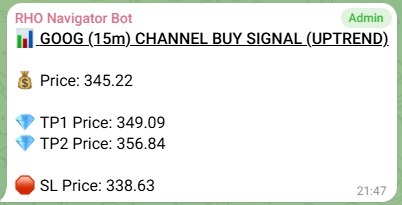
There’s one thing worth stressing, and the Navigator’s own guide is careful about it: a flagged level is a heads-up to look, not an instruction to trade. Even the buy and sell signals, as the guide puts it, are a prompt to open the chart and read it yourself, never the entry on their own. The tool doesn’t replace the judgement. You still do the hard work: read the chart, respect your stop-loss, and do nothing when there’s nothing worth doing. All it does is put the same picture Robin sees in front of you, faster.
The problem this solves
If you’ve traded before, you’ll know the feeling. You spot what looks like a good setup, you get in and then it moves the other way. Do you cut the loss, or give it room to recover? You hold on, hoping. Sometimes it comes back. Often it doesn’t, and a small loss turns into a painful one. The problem is rarely finding trades. It’s knowing where to get in, where to get out, and having the discipline to actually do it when the moment comes.
That’s exactly the gap Robin’s approach is built to close. A trade plan makes you decide everything up front. Where you get in, where you take profit, and the stop-loss that tells you when you’re wrong, before you’re in the trade and hope starts doing your thinking for you. The Navigator just puts that same structure on your chart, so you’re not figuring it out on your own.
It’s not for everyone, though. If you’re after something effortless, or overnight money, this isn’t it. But if you already dabble and want to stop trading on gut feel, or you’ve taken losses that a bit more discipline would’ve saved you from, or you just can’t sit and watch charts all day, this is for you.
Want to hear it from him?
Robin is running a free live session next week, where he’ll walk through how he builds a trade plan, how he reads trend, support and resistance, and how the Navigator puts those on your chart. Join the webinar to find out how you can get 3 months of a TradingView paid plan (worth S$297) free, even if you’re already a paying TradingView user.
📅 30 July 2026 · Thursday · 7:30pm SGT · Online 👉 Register free:


