


Anyone who checked their Singapore watchlist last week would have been forgiven for thinking it was only a bank story. OCBC lost 5.9% in a single session after a Citi downgrade, UOB and DBS followed, and the STI shed more than 5% over two days.
However, it wasn’t just the banks that ran red. We’ve picked out five non-bank stocks that have each fallen more than 10% over the past month to 9 October: SGX, City Developments, iFAST, Sheng Siong, and Keppel. SGX has been the clearest laggard, down about 16%, with CDL close behind at about 15%. The other three have also been sold down even though iFAST and Sheng Siong reported higher profits in their latest results and Keppel’s core business grew.


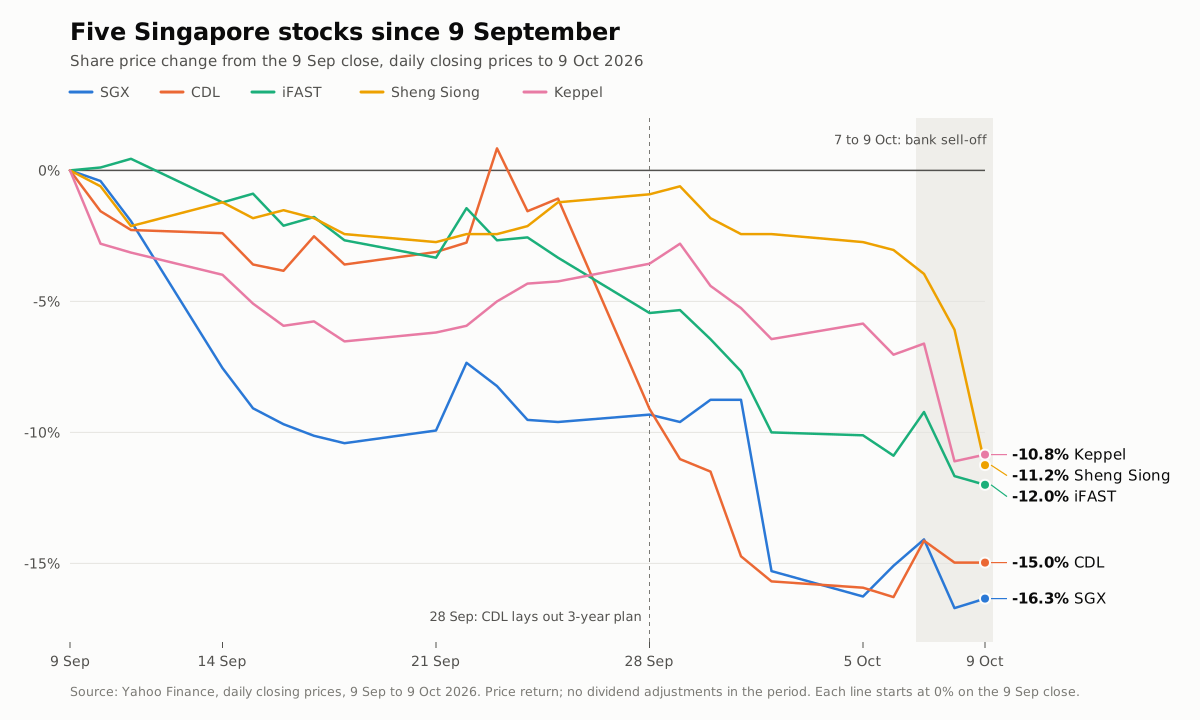
Most of these stocks had rallied hard through August and into the STI’s early September peak before giving back some of their gains as investors grew concerned about a US rate hike, oil above US$100 and stretched valuations.
These five also cover very different parts of the economy: an exchange, a developer, a wealth platform, a supermarket chain and an asset manager. So when they are sold toge`ther, the natural question is whether the market is seeing a common crack in Singapore’s growth story, or simply taking profits on whatever had run the furthest.
A Primer on the Singapore Market in Late 2026
Singapore stocks have had a remarkable year. The STI started 2026 at 4,646, crossed 5,700 in early August and peaked at 5,828 on 4 September, about 25% higher on the year. Even after last week’s sell-off, the index is still 16% higher year-to-date as of 9 October.

The strain shows up instead in the cost of money. On 16 September, the US Federal Reserve raised rates to 3.75% – 4.00%, its first hike since 2023, as an energy shock pushed inflation back up. Global bond yields rose with it, and Singapore-dollar deposit rates followed. Higher risk-free yields make a 2 – 3% dividend yield look less attractive and compress the multiples investors will pay for growth.
Layered on top of that is a geopolitical backdrop that soured through the middle of the year. Tensions in the Middle East have kept oil volatile, with Brent trading around US$100. For Singapore companies, that feeds through to fuel, utility and logistics costs, which several of our five already flagged as margin risks in their annual reports.
The market itself has yet to crack, but leadership has narrowed. The STI is heavily weighted toward the three banks, so when Citi cut its rating on OCBC to sell, citing flat third-quarter earnings and margin pressure from higher deposit rates, the index fell with it.
Valuations are part of the reason. Going into September, SGX traded at nearly 26 times forward earnings against a 10-year average of 22 times. Keppel was at about 21 times against a historical average of 9.5 times. Sheng Siong had reached more than 30 times. When rates rise, the most expensive stocks tend to fall first, regardless of how well the underlying businesses are doing.
Five Stocks, Five Stories: CDL Flashes a Warning Sign
The recent weakness across these five may look like a broad sell-off, but the latest annual report earnings suggest something more subtle. Every one of them reported higher profits in its latest annual report, and every one grew again in its most recent half-year. So far, the clearest case where the share price is reacting to the business, rather than the market, is CDL, which recently released the long-awaited strategic review on 28 September.
By contrast, iFAST and Sheng Siong are still growing earnings at double digits, and their declines look more like the unwinding of a premium. SGX and Keppel sit in between: their core engines are running, but each has a growth driver that is cyclical.
The question for investors is therefore not “what broke?” but “what was priced in?”
Singapore Exchange (S68) is a strong business currently priced for perfection, trading at 26x forward earnings compared with its historical average of 22x. FY2026 was a record year, with net revenue up 13.9% to S$1.48 billion and net profit up 7.8% to S$698 million (up 24.6% to S$760 million on SGX’s adjusted basis), but growth came from a cyclical surge in cash equities while its traditional equity derivatives engine remained flat. Management expects medium-term revenue growth to slow to 6 – 8%, slower than the 13.9% net revenue growth it just delivered. To maintain such growth, trading volume has to increase and that comes with market depth and a strong IPO market. If these prospects don’t grow in line or faster with volume, the trading action will likely be cyclical.
City Developments (C09) continues to face volatility and delayed structural improvements, weighing on its stock despite strong headline results. 1H2026 revenue rose 61% to S$2.72 billion and profit tripled to S$302 million, largely because of project completions that masked slower new unit sales and net gearing rising to 75%. A recent strategic review showed that planned capital recycling will take three years to reduce gearing to 55%, leaving investors with a prolonged wait for the anticipated re-rating.
iFAST Corporation (AIY) offers a structural growth story supported by recurring, fee-based revenue. Momentum continued into 2026, with 2Q2026 revenue up 34.8% and net profit up 35.0%, while assets under administration reached a record S$36.1 billion. The company raised its full-year dividend guidance to at least 12 cents, at least 43% more than last year. Headwinds include a delayed Hong Kong pension launch, but the core wealth platform continues to drive growth, and the UK digital bank is now profitable, though still small. Broader market downturns remain its primary fundamental risk.
Sheng Siong Group (OV8) shows how a defensive grocery stock can become a crowded trade after its valuation rises above 30x earnings. In 1H2026, revenue and profit each grew 11.9%, driven largely by new stores (12 opened in 2025 and four in the first half of 2026), rather than higher sales at existing locations. Management now targets three to five new openings per year and has warned of ongoing labour and utility cost pressures. Sheng Siong’s main business is in Singapore’s neighbourhood heartlands. There are only so many stores to open there, and same-store sales growth is tapering, so a 30x multiple needs a re-rating to hold.
Keppel (BN4) is making a successful but uneven transition into an asset manager. In 1H2026, its core New Keppel operations performed well, with net profit up 25% and funds under management surpassing S$100 billion. However, total group profit fell 59% after a S$375 million net loss on its non-core portfolio, mostly from legacy offshore rigs, and net debt rose to 6.7x EBITDA from 5.8x at the end of 2025. Trading at 21x earnings versus a historical average of 9.5x, the stock remains under pressure from its legacy portfolio.
Making Sense of the Disconnect
The size of each fall tends to line up more closely with how long the market thinks the growth can last than with how the business is doing.
SGX fell the most, about 16%, yet just reported its best year ever. iFAST is among the fastest growing and still gave back 12%. Sheng Siong and Keppel gave back about 11% each. That points to a market taking profits on what had run, as much as a verdict on any one business.
CDL is the exception. It fell about 15% and the cause was specific to the company: a strategic review that pushed the payoff out to FY2029. The market was not repricing a premium, it was repricing a timeline.
Many Singapore stocks have become crowded trades and are likely going to see some correction in the near term, even when the earnings are still arriving on schedule.
Is This the End of Singapore’s Re-Rating?
The natural next question is whether falling prices for some of Singapore’s best-performing stocks mean the market’s 2026 re-rating is over. So far, the evidence does not support a straightforward yes.
The structural supports are still in place. SGX’s FY2026 annual report shows 21 new listings and securities daily average traded value up 34.9%, helped by the Equities Market Review Group’s measures to revive the market. Those reforms, including smaller board lots and the Global Listing Board with Nasdaq, are still being rolled out. Even after last week’s sell-off, the STI is about 16% higher for the year.
What has changed is the price of that optimism. Several of these stocks were priced as if 2025’s conditions of rising volumes, falling rates and calm oil would continue. If the macro environment maintains and oil stays above US$100, earnings for rate-sensitive and cost-sensitive businesses, such as CDL’s gearing and Sheng Siong’s fuel and utility bills, could come under more pressure.
For now, the more plausible risk is slower growth rather than outright earnings declines. SGX’s volumes could normalise, Sheng Siong’s store openings will slow, and Keppel’s fee growth depends on fundraising in a tougher rate environment. None of that is a collapse, but none of it justifies the multiples these stocks reached in early September either.
Whether the resulting prices represent genuine value or a value trap will ultimately depend on how rates, oil and market volumes evolve through the rest of 2026. We remain selective in the current situation, preferring potential for growth (not just limited to Singapore for operations) and a stock with high near term payout ability (think strong dividend yields).
Join our Telegram to stay updated on the latest investing news: https://t.me/+TXFmvRr6tkgwYTc9


