


Container shipping rates reached a high in May 2024, which could partly contribute to sustained inflationary pressure.
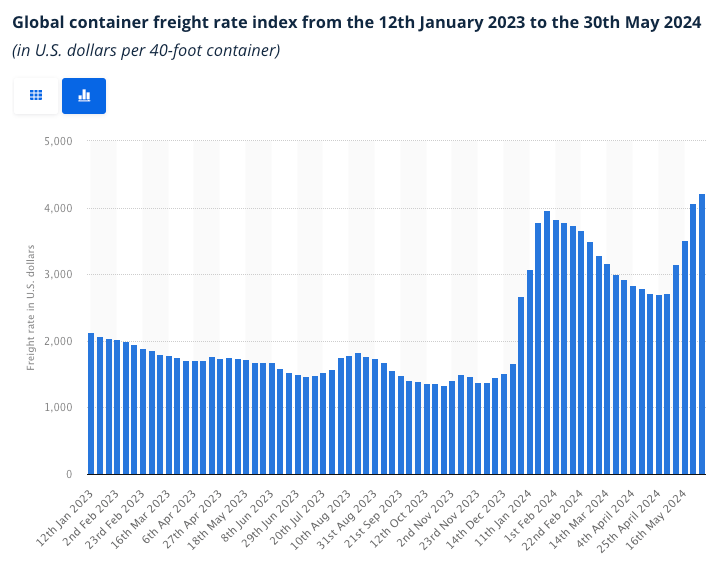
There could be two reasons driving these rates upwards. First, the Red Sea remains a danger zone due to the ongoing Middle East conflict, prompting ships to take the Cape of Good Hope route instead of the shorter Suez Canal route to avoid the Red Sea. This has led to longer transportation times and higher costs.


Second, the U.S. has imposed tariffs on Chinese goods such as EVs, batteries, and steel, causing China to rush to export these goods before the tariffs take effect.
We won’t see the Middle East conflict resolved quickly, and shipping companies are prepared to take the longer route as long as necessary. The same can be said for the U.S.-China trade war, which is not going away any time soon. Although the tariffs could eventually lower demand for Chinese goods, new tariffs could also be enacted, causing similar spikes in shipping behaviors in the future.
Many shipping stocks have rallied as a result, but it can be a mixed bag when looking at the largest shipping companies. Cosco Shipping (SEHK:1919), based in China, has been the best performer this year, gaining 76%. On the other hand, Hyundai Merchant Marine (KRX:011200) is down 7%. This suggests that China might be rushing to export goods before the tariffs take effect, which could explain the outperformance of the Chinese shipping company.

Container shipping is an oligopoly, with none of the major companies based in the U.S.; they are primarily located in Europe or Asia. If we focus on U.S.-listed shipping stocks, we mainly get dry bulk and tanker companies. Dry bulk carriers transport coal, iron ore, grains, and other commodities, while tankers ship crude oil and refined oil products. These companies are smaller, with many participants, forming a monopolistic competition market.
That said, some of their returns have been good too. Below is a select list of U.S.-listed shipping stocks, ranked from highest year-to-date returns to the lowest:

Ultimately, shipping stocks are cyclical, making them unsuitable for buy-and-hold strategies. Buy-and-hold investors typically avoid such stocks due to their volatility. However, these stocks can be attractive to value investors who are accustomed to buying during downturns and selling when the cycle is up. Given that many shipping stocks have already rallied, there is currently less value left for value investors. The more applicable strategy is momentum trading, but it requires know-how of trade and risk management. For those who are proficient in this area, the above list offers some trade ideas to explore.


